
 B
BAbout this program
891 stars on GitHub.
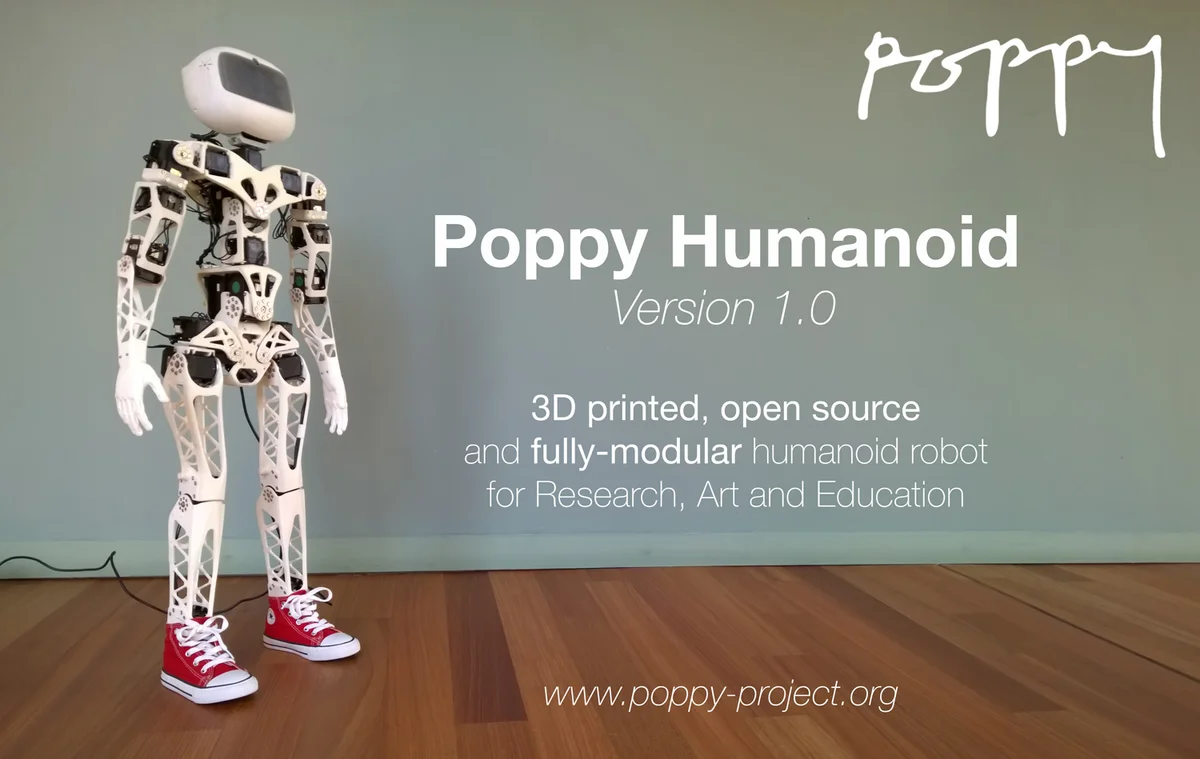
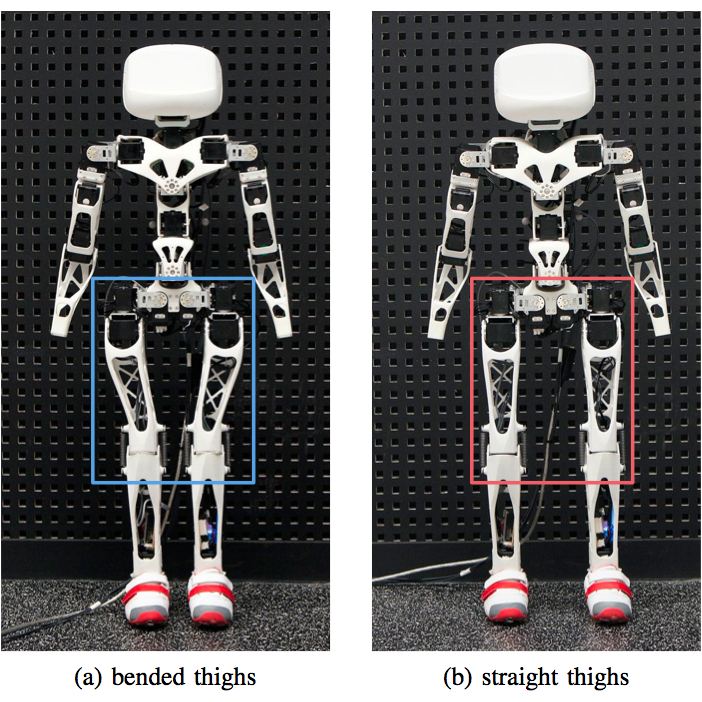
Poppy Humanoid is an open-source, 3D-printed, 25-DOF humanoid robot from the Poppy Project, originally developed at Inria's Flowers team for research in embodied cognition, human-robot interaction, and robot learning. Standing 84 cm tall and weighing about 3.5 kg, Poppy is designed with biomechanically motivated bent-thigh proportions and a deliberately "life-like" proportion philosophy: because the robot's morphology influences how humans perceive and interact with it, the researchers argued that a scientifically grounded body design is as important as the control algorithms that run on top of it.
Source: https://github.com/poppy-project/poppy-humanoid
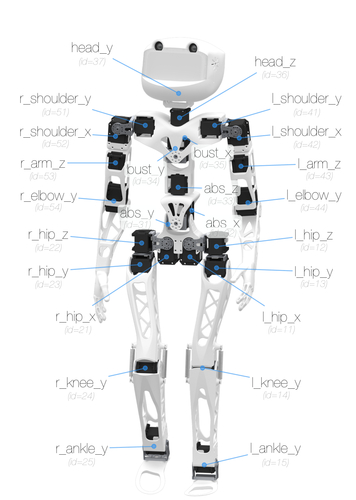
The robot uses 25 Dynamixel smart servos (MX-28 ×19 for legs, torso, and arms; MX-64 ×4 for the spine and hips; AX-12 ×2 for the head) communicating on a daisy-chained TTL bus. A Raspberry Pi onboard provides high-level control via pypot (the Python Dynamixel library developed for this project), with real-time joint targets streamed from user code. Compliant mode lets you back-drive the robot by hand to teach poses and trajectories — a powerful pedagogical and research primitive. Poppy Humanoid has been used in dozens of published studies on bipedal walking, imitation learning, developmental robotics, and tutor-assisted programming education.
Poppy is a modular family: the Torso variant is a desk-mountable upper body, and the Ergo Jr is a 6-DOF desk arm. Both share the Dynamixel bus stack and the pypot API. This means behaviors developed for one Poppy robot often port directly to another with configuration-level changes rather than code rewrites.
This program exposes cloud-side endpoints for rest/sit postures, arm waving, compliant-mode toggle, dance primitive playback, and full demonstration record/replay. The Raspberry Pi onboard bridges the orobot cloud to the Dynamixel bus via pypot.
Credit to the Poppy Project community and Inria Flowers team (poppy-project.org) — upstream repository at https://github.com/poppy-project/poppy-humanoid. Hardware under Creative Commons Attribution-ShareAlike 4.0 (hardware/LICENSE.md), software under GPLv3 (software/LICENSE). Share-alike requires derivative hardware designs to be published under the same CC-BY-SA-4.0 license.
Build Guide
Official assembly guide: docs.poppy-project.org
🖨 Print Files (44)
head_visual.STL
chest_visual.STL
abdomen_visual.STL
bust_motors_visual.STL
l_shoulder_visual.STL
l_forearm_visual.STL
Required Hardware
| Component | Qty | Notes |
|---|---|---|
| Robotis Dynamixel MX-28 servo | 19 | Legs, torso, and arms |
| Robotis Dynamixel MX-64 servo | 4 | Spine (abs) and hips |
| Robotis Dynamixel AX-12 servo | 2 | Head (pan and tilt) |
| Raspberry Pi 3 or 4 | 1 | Main controller |
| USB2Dynamixel or U2D2 adapter | 1 | Serial bus interface |
| 12V power supply (5A+) | 1 | Servo power rail |
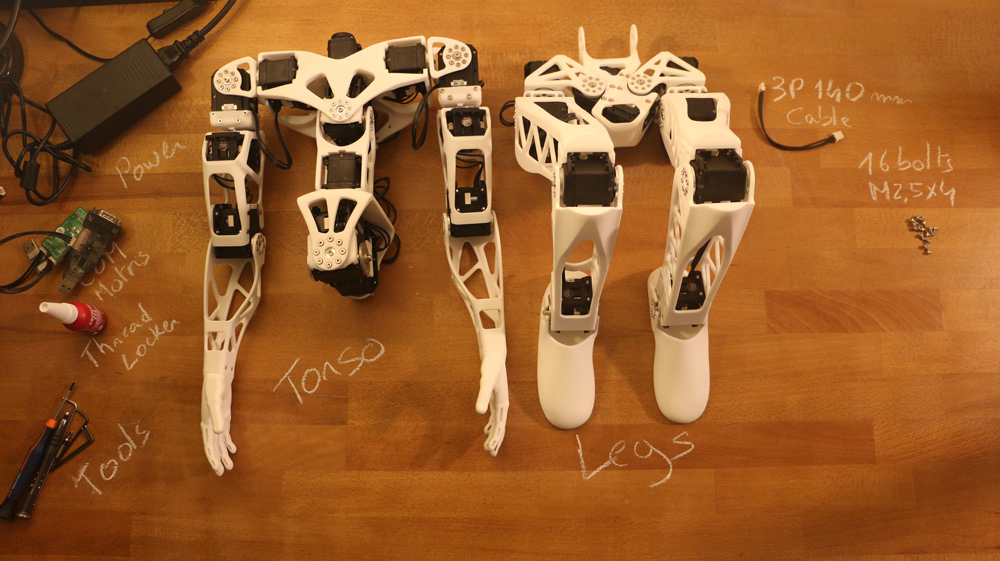
| 3D printed structural parts | 1 set | ~33 printable STL files (download from official release 1.0.2) |
| M2/M3 hardware | assorted | Dynamixel horn screws and frame bolts |