Community-built robots you can build, run, and own
 Humanoids
Stack-chan
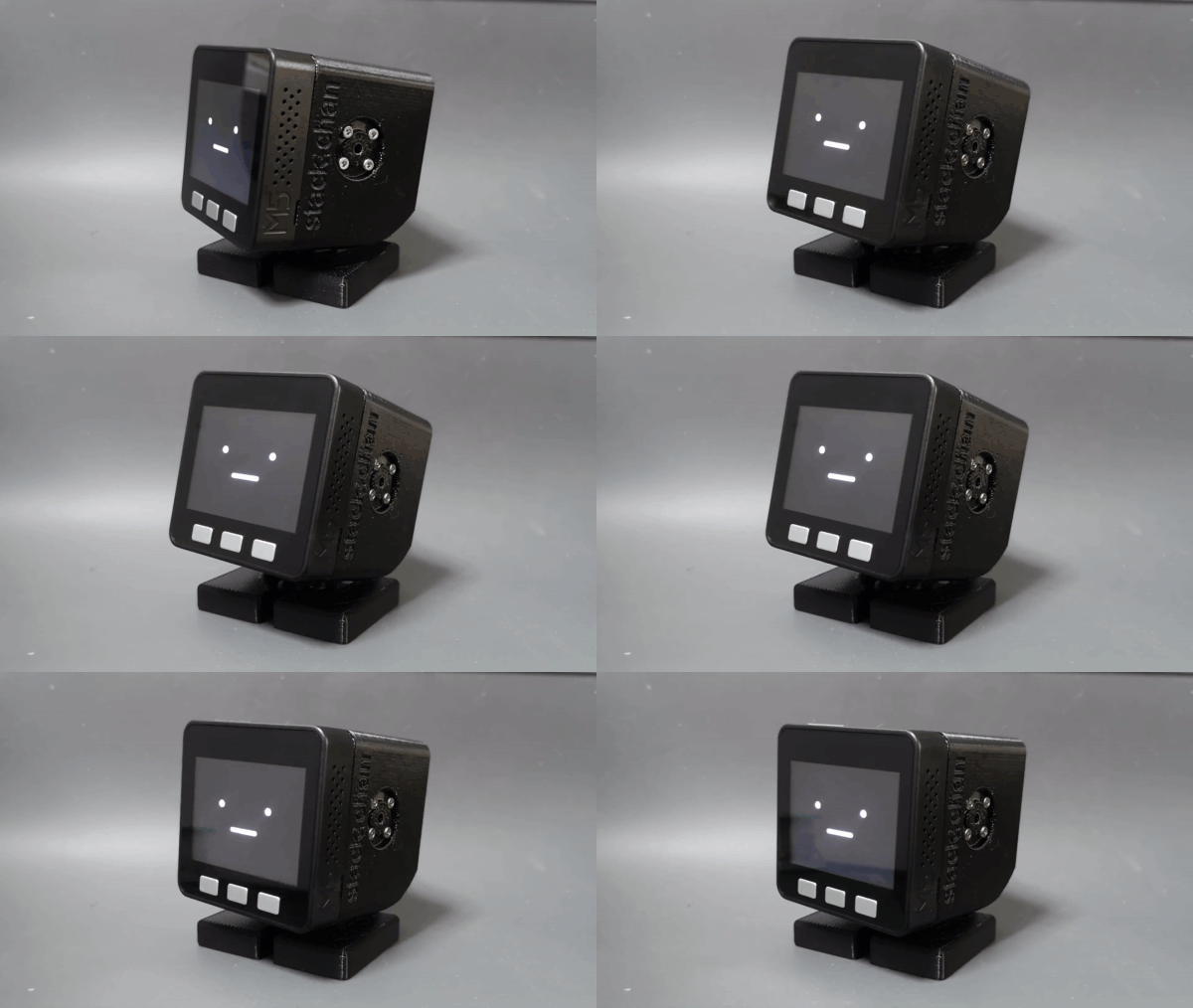
1,382 stars on GitHub. Stack-chan is a palm-sized, open-source "super-kawaii" companion robot driven by an M5Stack microcontroller and JavaScript firmware. Created by Shinya Ishikawa, Stack-chan sits on your desk, turns its head to watch you, expresses emotions on its built-in display, and responds through speech — a personality in a box you can hold in one hand. Source: https://github.com/meganetaaan/stack-chan The firmware is written on the Moddable SDK, a JavaScript framework for embedded systems, making the robot programmable without leaving the web development ecosystem. Behaviors — called "mods" — are composable: face expressions (happy, angry, sad), servo-driven head tracking, speech synthesis, and M5Stack unit add-on support can all be mixed and layered. The 3D-printable enclosure is modular and supports multiple servo configurations: the default case uses SG90 or MG90S servos for pan/tilt, while a second design (RS30X series) uses higher-torque TTL servos for smoother motion. The 46-part printable set covers the main shell, bracket, feet, spacer, accessories (hat, backpack variants, Lego adapter), and servo-specific geometry for SCS0009, SG90, MG90S, and RS30X actuators. An official M5Stack commercial version (StackChan) is also available, with the community meganetaaan fork remaining the primary open-source hardware and firmware reference. License: Apache 2.0.
from $130🛠 BoM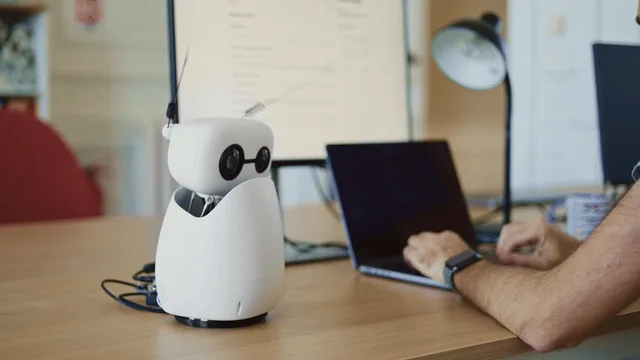 Humanoids
Reachy Mini
Expressive open-source robot for hackers and AI builders
from $299🛠 BoM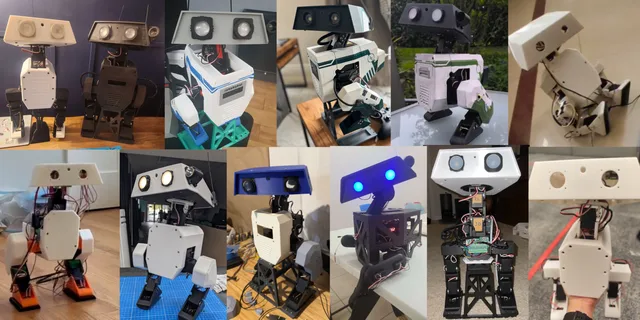 Humanoids
Open Duck Mini
2,642 stars on GitHub. Open Duck Mini — Bipedal BDX Droid Replica Source: https://github.com/apirrone/OpenDuckMini A miniature bipedal character robot inspired by Disney's BDX droid (the little star of the Galactic Starcruiser walkabout experience and several Disney+ trailers). Designed by Antoine Pirrone (apirrone), Open Duck Mini scales that silhouette down to about 35 cm tall and lets you build one for a few hundred dollars in parts. What it is A walking, head-tilting, antenna-twitching little biped with serious character. Under the cute exterior it's a legitimate RL-trained biped: Legs trained in Isaac Gym, sim-to-real transferred to physical hardware Standing-up-from-fall policy with demonstrated perturbation robustness Sim2Sim pipeline through Mujoco for validation before hardware deployment Head + antennas add expressiveness on top of the locomotion stack Hardware Servos: Dynamixel XC330-M288-T across all joints (upgraded from XL330 for torque headroom on landing impacts) IMU: BNO055 9-axis for base orientation estimate Compute: an onboard board (RPi-class or similar SBC) running the learned policy Battery: small LiPo in the cage, hot-swappable What you can do with it Run the pretrained walking policy straight from the repo — step the robot around, send it forward/turn commands over the orobot cloud surface. Collect your own episodes — use the remote surface here as the operator input for demos. Research biped RL — swap in your own PPO / SAC training runs; the Mujoco and Isaac scenes are all published. Character animation — antenna and head servos give it genuine personality for demos, events, or as a companion prop. Printed parts (canonical set shipped with this program) , — shell and torso , — hip assemblies — leg reinforcement , — joint linkages — contact surface , , — internal electronics cage , — head antennas The full repo includes ~130 STLs covering wiring routing, battery variants, and community mods (see Jaime's v2 mods and Justin's "Park Head" variant in the upstream tree). Attribution & license Designer: Antoine Pirrone (apirrone) Upstream: https://github.com/apirrone/OpenDuckMini License: Apache 2.0 Related: Duck community mods + variants under in the upstream repo Links Upstream: https://github.com/apirrone/OpenDuckMini Training code: https://github.com/apirrone/OpenDuckMiniRuntime BDX inspiration: Disney's Galactic Starcruiser droid --- Install Notes The orobot action runs the MuJoCo simulation training script (), not the physical robot deployment. The actual walking firmware for the physical duck lives in a separate repository: apirrone/OpenDuckMiniRuntime. To run on hardware, clone the Runtime repo separately, deploy to a Raspberry Pi Zero 2W, and update the action in this Program's editor to point at the Runtime's main script.
from $1400🛠 BoM Humanoids
Poppy Humanoid
891 stars on GitHub. Poppy Humanoid is an open-source, 3D-printed, 25-DOF humanoid robot from the Poppy Project, originally developed at Inria's Flowers team for research in embodied cognition, human-robot interaction, and robot learning. Standing 84 cm tall and weighing about 3.5 kg, Poppy is designed with biomechanically motivated bent-thigh proportions and a deliberately "life-like" proportion philosophy: because the robot's morphology influences how humans perceive and interact with it, the researchers argued that a scientifically grounded body design is as important as the control algorithms that run on top of it. Source: https://github.com/poppy-project/poppy-humanoid The robot uses 25 Dynamixel smart servos (MX-28 ×19 for legs, torso, and arms; MX-64 ×4 for the spine and hips; AX-12 ×2 for the head) communicating on a daisy-chained TTL bus. A Raspberry Pi onboard provides high-level control via pypot (the Python Dynamixel library developed for this project), with real-time joint targets streamed from user code. Compliant mode lets you back-drive the robot by hand to teach poses and trajectories — a powerful pedagogical and research primitive. Poppy Humanoid has been used in dozens of published studies on bipedal walking, imitation learning, developmental robotics, and tutor-assisted programming education. Poppy is a modular family: the Torso variant is a desk-mountable upper body, and the Ergo Jr is a 6-DOF desk arm. Both share the Dynamixel bus stack and the pypot API. This means behaviors developed for one Poppy robot often port directly to another with configuration-level changes rather than code rewrites. This program exposes cloud-side endpoints for rest/sit postures, arm waving, compliant-mode toggle, dance primitive playback, and full demonstration record/replay. The Raspberry Pi onboard bridges the orobot cloud to the Dynamixel bus via pypot. Credit to the Poppy Project community and Inria Flowers team (poppy-project.org) — upstream repository at https://github.com/poppy-project/poppy-humanoid. Hardware under Creative Commons Attribution-ShareAlike 4.0 (hardware/LICENSE.md), software under GPLv3 (software/LICENSE). Share-alike requires derivative hardware designs to be published under the same CC-BY-SA-4.0 license. Build Guide Official assembly guide: docs.poppy-project.org
from $1050🛠 BoMBrowse by type