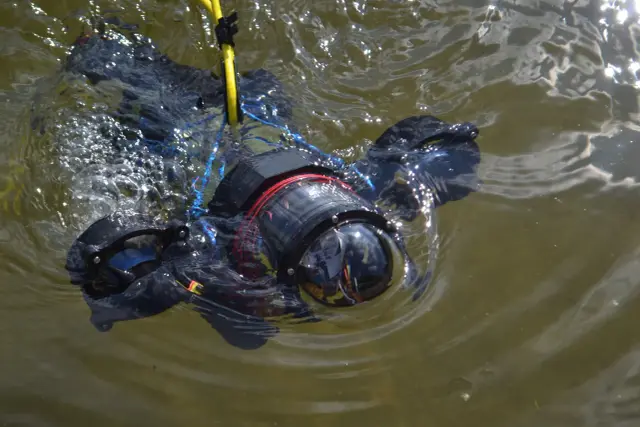
Underwater Drone
$105075 stars on GitHub. This open-source customisable underwater drone is a 3D-printable submersible robot designed by Guido and Fabio Schillaci at Humboldt-Universitat zu Berlin. Published as an arXiv preprint, the design enables multiple propeller and thruster configurations for varying research and exploration tasks. Source: https://github.com/guidoschillaci/underwater-drone The drone is built around the 4" watertight enclosure sold by BlueRobotics, providing a waterproof housing for electronics. Thrusters use brushless motors (see note below on component versions); all 18 structural components are 3D-printable and recommended to be printed with solid infill for watertight structural integrity. The modular clamp system allows configuring the drone for different mission profiles — forward-facing cameras, lateral thrusters, ballast placement, or instrument mounting. See Print Files for the full list of 18 printable components. Thruster note: the description references Turnigy Aerodrive DST (DST-700/DST-1200) brushless motors; some BOM links point to the ApisQueen 5060 Waterproof Brushless Underwater Motor instead. Verify which motor you are sourcing before purchase — the two are not the same form factor. Applications include aquatic research, underwater exploration, coral reef monitoring, and educational robotics. License: Creative Commons Attribution 4.0 International (CC-BY 4.0). --- Install Notes This repository contains CAD files and assembly instructions for a 3D-printable submersible — there is no firmware or control software included. The design is intended for custom electronics integration. The orobot Program code is a reference stub only. To build a controllable version, you will need to design or source your own motor controller and connect it via serial or WiFi. Build Guide 3D models, build instructions, and configuration details: github.com/guidoschillaci/underwater-drone --- Printing This Print All set maps 1:1 to the upstream folder — all 18 structural components, no sim meshes or duplicates. Print in PETG (hydrolysis-stable) with solid / near-100% infill for watertight structural integrity. Quantities (4-thruster configuration)
The drone uses 4 thrusters, so thruster and propeller parts repeat: | Part | Qty | Notes |
|------|-----|-------|
| thrustermain.stl | 4 | One per thruster |
| thrustercap.stl | 4 | One per thruster |
| thrustermotormount.stl | 4 | One per thruster |
| thrusterdst2bluerovadapter.stl | 4 | Motor-to-housing adapter (one per thruster) |
| propeller.stl | 4 | One per thruster (or use motor-matched commercial props per BOM) |
| clampanteriorsuperior.stl | 1 | Modular clamp |
| clampanteriorinferior.stl | 1 | Modular clamp |
| clampposteriorsuperior.stl | 1 | Modular clamp |
| clampposteriorinferior.stl | 1 | Modular clamp |
| posteriorclamp2tubeconnector.stl | 1 | Clamp-to-tube connector |
| rearclampconnector.stl | 1 | Rear clamp connector |
| adapter90.stl | 1+ | Tube adapter |
| adapterroundmale.stl | 1+ | Tube adapter |
| adapterroundfemale.stl | 1+ | Tube adapter |
| adaptersplit.stl | 1+ | Tube adapter |
| stick.stl | 1+ | Structural rod |
| ballastcylinder.stl | 1+ | Ballast tube |
| ballastcap.stl | 1+ | Ballast cap | Modular by design: the clamp/adapter/ballast system is meant to be reconfigured for different mission profiles (forward camera, lateral thrusters, ballast placement). Print extra adapters, sticks, and ballast cylinders to suit your chosen layout — the counts above are a baseline for a standard 4-thruster build. Motor note: the upstream design targets Turnigy Aerodrive DST motors (hence ); if you source the ApisQueen 5060 motor listed in some BOM links, the motor-mount fit differs — verify before printing the thruster mounts.
🍓Raspberry Pi