3D Print Open Source AI Robots
 Mobile Robots
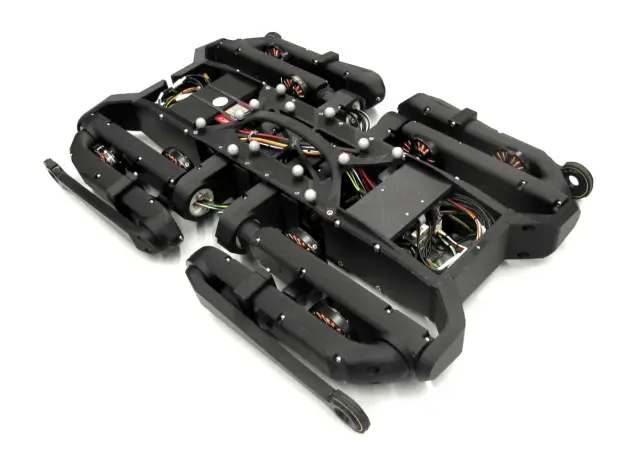
Solo12 Quadruped
$5000Solo12 is an open-source 12-DOF quadruped robot from the Open Dynamic Robot Initiative (ODRI), a collaboration between MIT, LAAS-CNRS, NYU, and MPI-IS to provide the legged-locomotion research community with an affordable, reproducible platform for dynamic control research. The robot has four legs, each with three degrees of freedom (hip abduction/adduction, hip flexion/extension, and knee), actuated by ODRI's open-source brushless direct-drive actuator modules. Direct-drive transmissions give the robot high-bandwidth torque control and transparent dynamics — critical for whole-body MPC, reinforcement learning, and contact-rich locomotion experiments that are difficult or impossible on geared quadrupeds. Solo12 has been used in dozens of published locomotion papers studying bounding gaits, stair climbing, reactive balance control, sim-to-real reinforcement learning, and model-predictive control. The full hardware and software stack — actuator PCBs, mechanical CAD, master board firmware, real-time control interface, and Pinocchio-based dynamics — is published under BSD-3-Clause, making Solo12 one of the most accessible research-grade quadrupeds available. This program provides cloud-side locomotion commands (stand, sit, directional walking, trot, emergency stop) that relay to the onboard controller over WebSocket. The hardware requirement is a Raspberry Pi 4 acting as the high-level controller; the real-time low-level control loop runs on the master board over EtherCAT/SPI to the 12 actuator modules. Credit to the Open Dynamic Robot Initiative consortium (LAAS-CNRS, MPI-IS, NYU, MIT) — upstream repository at https://github.com/open-dynamic-robot-initiative/openrobotactuatorhardware under BSD-3-Clause. Build Guide Step-by-step assembly instructions for the Solo12 quadruped: Solo12 hardware README Printing Solo12 is a research-grade direct-drive quadruped — most of the robot is custom electronics, machined aluminium, and ODRI actuator modules, so the 3D-printed set is intentionally small (this is the correct, complete print set, not a partial one). The 11 parts below are the Solo12-specific printable components, curated from the much larger ODRI repo (which contains 200+ STLs spanning tools, jigs, and other robot configurations). PLA/PETG, ~214 cm³ total. Leg hip modules — print one per corner (4, all distinct): solo12hipfefl (front-left), solo12hipfefr (front-right), solo12hipfehl (hind-left), solo12hipfehr (hind-right) These are the hip flexion/extension housings; each corner is a separate handed part — print all four. Body frame — print one each (5): bodystructurecenter, bodystructureside, bodystructuretopimu (top plate with IMU mount) hipadapter (mounts the hip modules to the body) ledcover (status-LED cover for the NeoPixel ring) Assembly stand (accessory — 2): standfoot and standfork form a benchtop stand/cradle used to hold the robot during assembly and calibration. This is an accessory/jig, not part of the walking robot — print it if you want the stand, skip it otherwise. Not printed: the 12 ODRI brushless direct-drive actuator modules, 6 micro-driver PCBs, master board, IMU, timing belts, bearings, and machined plates are all sourced/fabricated per the BOM — only the parts above are 3D-printed.
 Mobile Robots
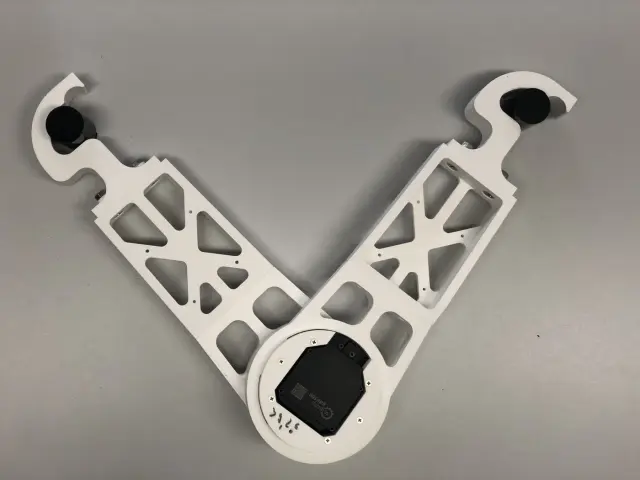
AcroMonk Brachiating Robot
$105054 stars on GitHub. AcroMonk is a minimalist underactuated brachiating robot — it swings hand-over-hand across a horizontal ladder bar using just one quasi-direct drive (QDD) actuator and passive grippers. Published in IEEE Robotics and Automation Letters 2023 (featured in IEEE Spectrum Video Friday), it is the first brachiator with unactuated grippers that can perform more than two consecutive brachiation maneuvers. Source: https://github.com/dfki-ric-underactuated-lab/acromonk The robot is built from a single brushless QDD motor (MIT Cheetah-style), 3D-printed structural links, and simple passive hook grippers that rely on gravity and swing momentum for release and re-grasp. The absence of gripper actuators dramatically simplifies the mechanical design while making the control problem much harder — AcroMonk must time its swing precisely. Control methods include trajectory stabilization via TVLQR (time-varying LQR) and reinforcement learning. A full simulation environment (MuJoCo/PyBullet) is provided alongside hardware controllers. The kit is designed to be an affordable research testbed for underactuated locomotion research. Hardware: 1× quasi-direct drive brushless actuator (MIT Cheetah motor or equivalent), 3D-printed links and gripper hooks, horizontal ladder test bar. Open source under BSD-3-Clause license with accompanying IEEE RA-L paper. Build Guide Hardware build files, BOM, and assembly docs: github.com/dfki-ric-underactuated-lab/acromonk/tree/main/hardware
 Mobile Robots
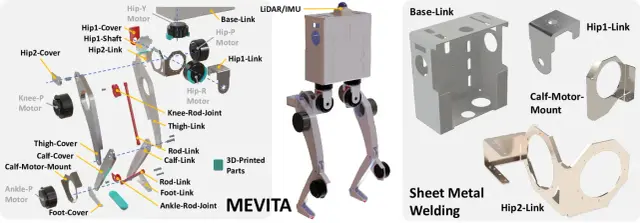
MEVITA Biped
$630090 stars on GitHub. MEVITA is an open-source bipedal robot designed to be assembled entirely from e-commerce components — sheet metal parts, machined elements, and off-the-shelf actuators — without access to specialized manufacturing. A sister project to MEVIUS (quadruped), MEVITA extends the approach to two-legged locomotion research. Published at IEEE conference proceedings with accompanying arXiv paper. Source: https://github.com/haraduka/mevita The robot has 10 degrees of freedom across two legs (5 DOF per leg: hip yaw, hip roll, hip pitch, knee pitch, ankle pitch), driven by CubeMars AK70-10 and AK10-9 V2.0 brushless actuators. All meshes are provided for full 3D-printable structural parts. A Livox LiDAR provides depth sensing for environment mapping. MEVITA runs ROS1 with reinforcement learning policies trained in Isaac Gym (leggedgym framework). The two-phase training pipeline first learns stable walking, then fine-tunes with varied friction and command distributions. Motor control uses CAN bus via RUBIK LINK V2.0 adapter. Hardware: 10× CubeMars AK70-10/AK10-9 brushless actuators, RUBIK LINK V2.0 CAN interface, Livox LiDAR, Intel RealSense T265. Open source under MIT license. --- Install Notes MEVITA has the same hardware requirements as MEVIUS. It requires a CAN bus interface** (e.g., PEAK PCAN-USB) connected to the Pi before will work — call first to initialize it. The actuators are quasi-direct-drive motors, not hobby servos. See the MEVITA hardware guide for compatible actuator specifications.
Browse by type
Browse by hardware
Browse by difficulty