3D Print Open Source AI Robots
 Arm Robots
Pedro Robot Arm
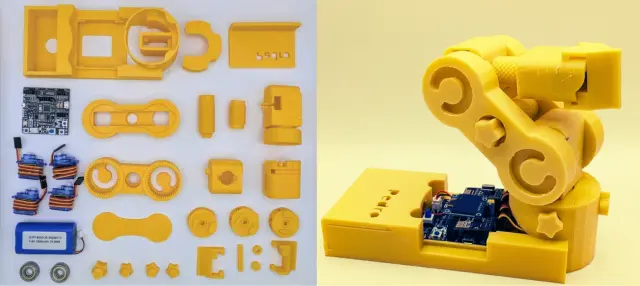
$40Pedro is a fully open-source, 3D-printable educational robot arm designed for STEM classrooms and makers who want to learn robotics from scratch. With only four printable parts, four mini servo motors, and tool-free snap-together assembly, Pedro can be built and operational in under 10 minutes.Design Philosophy Source: https://github.com/mattions/pedro Pedro is intentionally minimal. The entire structure consists of four 3D-printed components — BASE, ARM, GEAR, and SERVO bracket — that snap and gear together without screws or adhesive. This makes it ideal for workshops where dozens of students can assemble their own robot simultaneously. All parts print in under 2 hours on any FDM printer at 0.2mm layer height in PLA or ABS. Electronics Pedro is powered by a custom Arduino-compatible controller board called the Pedro Board, which integrates four servo outputs, an nRF24L01 radio module for wireless control, an HC-05 Bluetooth module for smartphone connectivity, and an ESP8266 for WiFi and IoT integration. Power comes from a 7.4V LiPo battery rechargeable via USB. Control Modes Pedro supports five control modes: Manual (serial/USB from a PC), Radio (nRF24L01 remote), Bluetooth (smartphone app), Replay (execute recorded sequences), and Record (capture and store movement sequences). The firmware is built on the Arduino platform and is fully open source under Apache 2.0 in the PedroRobot repository. Community Pedro is used in over 70 schools and educational workshops across France and internationally. The project ecosystem includes Pedro Board (PCB gerbers + schematics), PedroRobot (Arduino firmware), and PedroSTEM (complete lesson plans and activities). All repositories are published under Apache 2.0 by Almoutazar Saandi. Printing Print files match the upstream source repository (github.com/mattions/pedro, ) one-to-one — all nine parts are byte-identical to the repo. Structural parts (print 1 each): — base / shoulder servo mount — elbow servo mount — wrist servo mount — wrist joint — end effector / tool point , — remaining structural links (repo ships these under generic names) Mirror pair (print both, not alternates): + — the two halves of the forearm; both are required. Servos: 4 × Tower Pro SG90 9g micro servos (base, shoulder, elbow, wrist). The Pedro Board PCB (or an Arduino Uno/Nano substitute) and all electronics are sourced from the BOM, not printed. Cleanup note: Four extra files (, , , ) were removed — they are not present in the cited source repo, their byte sizes did not match any repo part (e.g. was an anomalous 7.6 MB), and the hero photo shows the multi-part repo design rather than the four-piece snap-together variant described in the older marketing text above. Keeping them would have over-printed parts from a different design.
 Home Automation
DIY SmartLock
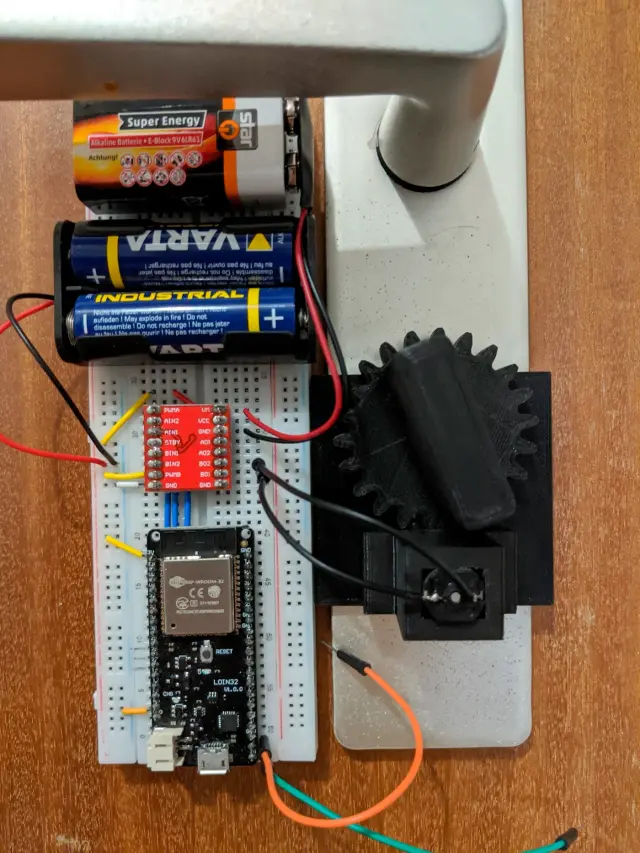
$37DIY SmartLock A battery-powered 3D-printed smart lock powered by an ESP32 and driven by an N20 geared motor. Designed for residential door locks, it replaces the manual key turn with touch-triggered automation — touching the metal door knob from outside wakes the ESP32 from deep sleep and checks MQTT for authorization before unlocking. How It Works The ESP32 spends nearly all of its time in deep sleep (as low as 5.2 µA on bare ESP32), waking only when the capacitive touch sensor detects contact with the door knob. On wake it connects to WiFi, subscribes to an MQTT topic (door/auth), and drives the N20 motor clockwise or counter-clockwise to lock or unlock. The system integrates naturally with Node-RED, Home Assistant, or any MQTT-capable automation stack for presence-based auto-auth. Important: The N20 motor must operate at 9 V — 3–6 V versions will not reliably actuate the door trap. Specifications | Property | Value | |---|---| | Controller | ESP32 (bare WROOM-32 or LOLIN D32) | | Motor | N20 geared DC motor (9 V, ~40 mA no-load) | | Motor Driver | TB6612FNG (direct GPIO control) | | Power — Logic | 2x AA alkaline batteries (~3.2 V) | | Power — Motor | 9 V block battery | | Deep Sleep Current | ~5.2 µA (bare ESP32), 125 µA (LOLIN D32) | | Wake Trigger | Capacitive touch sensor (ESP32 pin T2) | | Connectivity | WiFi 802.11 b/g/n + MQTT | | Printed Parts | 4 STLs (base, gear-motor, cage-motor, gear-key-knob) | | Build Difficulty | Intermediate | | Firmware | Arduino / PlatformIO | Attribution Designer: Florian Vogler (@vogler on GitHub) Source: https://github.com/vogler/SmartLock License: Source-available (no explicit open-source license — check repo for usage terms) 3D Model: https://a360.co/4lLHHwa (Fusion 360, downloadable in multiple formats) Build Album: https://photos.app.goo.gl/bewiZ1qH8sHnJjmg7 Printing Print one of each of the four parts: 1-base (the mounting base), 2-gear-motor (motor drive gear), 3-cage-motor (motor cage/housing), and 4-gear-key-knob (the key knob gear). Together these make one complete SmartLock mechanism. Note: the upstream source also includes a file named 0-SmartLock-assembled, which is a fully assembled preview model of the whole lock — it is a visual reference for how the parts fit together, not a printable part. It has been excluded from this Print All set so the list yields exactly the parts you need to build the lock.
 other-robots
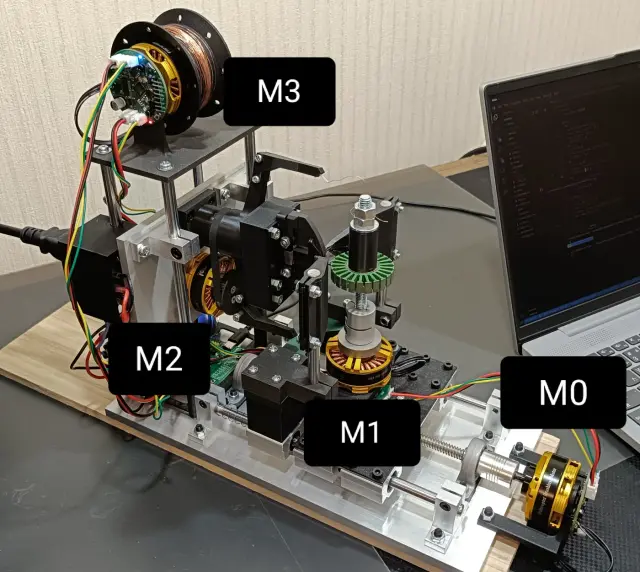
Winder — BLDC Motor Winding Machine
Automated 4-axis stator winding
Browse by type
Browse by hardware
Browse by difficulty