3D Print Open Source AI Robots
 Mobile Robots
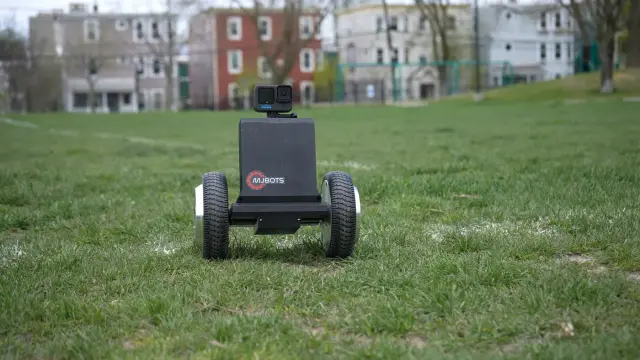
mjbots Hoverbot
$50057 stars on GitHub · Apache 2.0 · Josh Pieper / mjbots A compact 2-wheeled robot built around surplus hoverboard hub motors for outdoor and semi-rugged terrain. Designed by Josh Pieper of mjbots. Source: https://github.com/mjbots/hoverbot Capabilities: Hoverboard hub motors (2×) driven by mjbots moteus-c1 brushless FOC controllers (CAN-FD) mjbots pi3hat handles IMU (gyro + accelerometer) and CAN-FD bus aggregation Raspberry Pi 4 runs control software via CAN-FD Fully 3D-printable PETG chassis with M3/M2.5 heat-set inserts Optional GoPro mount for first-person video Runs for hours; handles grass, gravel, and uneven pavement Sourcing heads-up: mjbots specialty parts only — moteus-c1, pi3hat, and powerdist are from mjbots.com, not Amazon 18V drill battery driving 36V-rated motors** — deliberately limited to ~2 m/s top speed, mechanically safe but not stock hoverboard performance
 Mobile Robots
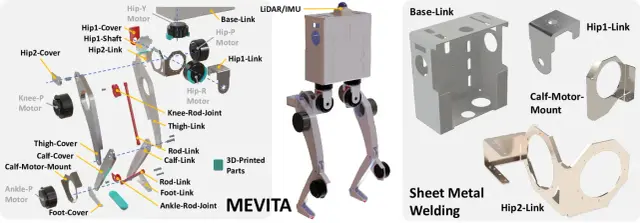
MEVITA Biped
$630090 stars on GitHub. MEVITA is an open-source bipedal robot designed to be assembled entirely from e-commerce components — sheet metal parts, machined elements, and off-the-shelf actuators — without access to specialized manufacturing. A sister project to MEVIUS (quadruped), MEVITA extends the approach to two-legged locomotion research. Published at IEEE conference proceedings with accompanying arXiv paper. Source: https://github.com/haraduka/mevita The robot has 10 degrees of freedom across two legs (5 DOF per leg: hip yaw, hip roll, hip pitch, knee pitch, ankle pitch), driven by CubeMars AK70-10 and AK10-9 V2.0 brushless actuators. All meshes are provided for full 3D-printable structural parts. A Livox LiDAR provides depth sensing for environment mapping. MEVITA runs ROS1 with reinforcement learning policies trained in Isaac Gym (leggedgym framework). The two-phase training pipeline first learns stable walking, then fine-tunes with varied friction and command distributions. Motor control uses CAN bus via RUBIK LINK V2.0 adapter. Hardware: 10× CubeMars AK70-10/AK10-9 brushless actuators, RUBIK LINK V2.0 CAN interface, Livox LiDAR, Intel RealSense T265. Open source under MIT license. --- Install Notes MEVITA has the same hardware requirements as MEVIUS. It requires a CAN bus interface** (e.g., PEAK PCAN-USB) connected to the Pi before will work — call first to initialize it. The actuators are quasi-direct-drive motors, not hobby servos. See the MEVITA hardware guide for compatible actuator specifications.
Browse by type
Browse by hardware
Browse by difficulty